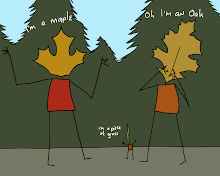
Discussion question: Do you think it's okay to label bands like Poison and Black Sabbath under the same genre of heavy metal, or should there be a definite distinction?
Wednesday, April 1, 2009
Walser's "Running With the Devil" Critical Review
In "Running With the Devil," Walser takes a look at metal music in a way that other scholars have rarely done. He starts his chapter with a look at the history of heavy metal music, with its roots in such bands as Led Zeppelin, Black Sabbath, and Deep Purple. Walser also identifies when and where the term metal or heavy metal was first used, citing old dictionary definitions of the term, the Steppenwolf song, Born to be Wild, and then a William S. Burroughs book. What Walser does that other scholars don't do is talk about the music itself, identifying such things as the power chord and the bass heavy and melodic sounds as defining characteristics of heavy metal as a genre. In writing this chapter in his book, Walser wants readers to "examine [academic's and critic's] views critically in order to clear space for a different sort of account of heavy metal." (25) If their views are looked at this way, maybe some of the stereotypes that have been developed will be overlooked and a more widespread, true appreciation for the virtuosic playing will blossom.

Wednesday, March 18, 2009
Schloss's "B-boy Culture" Critical Review
Schloss opens up his B-boy culture article by giving the reader a little background to the activity. He lets us know the roots of B-boying, saying that the dance developed in New York City in the early 1970s, and that it's musical roots are based in rock and funk songs. He also defines how battles take place in areas such as gymnasiums, clubs, or when it's nice out, basketball courts; anything that has a flat ground. Battles also have a pretty normal competition layout, with a pre-determined number of rounds, where one competitor is eliminated each round, and eventually a winner is declared.
After giving some history to B-boying, Schloss discussed the canon of it, and the high importance of the canon. B-boying's canon consists of old school songs such as "Apache," "Just Begun,"and "The Mexican," all songs that to what Schloss discovered, almost every B-boy and B-girl knows. The canon serves as important gateway between the past and the present. It keeps people in touch with the roots of the activity, and by following these songs, and knowing them by heart, it gives a great deal of respect for the originators of the activity. Since these are songs that are often played a great deal, knowing them is in every B-boy and B-girl's best interest because when they come on, it can be the perfect time to show off your best moves. This canon also serves as a bridge between the DJ and the breakers. By having these songs in their repertoire, DJs can bust them out, and let people start breaking, and from this they can gain more respect in the B-boy world. The canon also serves to create a sense of community. Since virtual all B-boys know, or should know the canon, it's something that everyone who participates in the culture shares. This shared sense of what the best songs to break to creates the community of B-boying. The canon brings the B-boy culture together and enables it to live on throughout the decades after its creation.
Question: If it weren't for the B-boy canon, would there still be able to be the shared sense of a community between the culture's participants?
Monday, March 16, 2009
Revived by revivalists: Black Lips in Boston
Sitting with friends in Harvard/Central Square on a nice night, sipping on a strong rum and coke out of a pop cup is a great way to spend a Saturday, until it starts raining. It came as a few drops at first, but then started coming down pretty steadily. So what turned out to be a nice little chat to kill some time before the show was going to begin turned into a huddle session in the entrance of a pizza joint. From my past experience with shows in Boston, the crowds haven't been the best ones I've been a part of, so I was hoping it wouldn't turn out to be that way again. There was only one way to find out. We finished up our drinks, and with a nice buzz and an excited attitude, walked into the Middle East for the show.
After having our real ids scrutinized by the door girls (like I would lie about being 20) we stepped into the rather empty downstairs room. Even though the room looked pretty empty, it was still early, and I heard some people talking about how the show had sold out, so there was certain to be a large crowd. My friends and I took the opportunity to make our ways to the front of the stage and stake out our spots for when the Black Lips came on. The front row was already taken up by what seemed to be diehard fans, each one with their cameras in hand, ready for a surprise appearance of a band member before their set. At one point, the Black Lips bass player, Jared Swilley, walked across the room, trying to make his way towards backstage, and the two diehard fans in front of me proved how much they like the band as they both literally ran over to him to get a picture. It opened up two spots in the front row, but we were pretty content with there we were standing. They came back, took their spots, and I said to one of them, "that's awesome, getting a picture with Jared. I wish I had a camera with me." He kind of nonchalantly replied, "yeah, I always bring my camera with me." We started talking about their new album, which had just come out eleven days earlier on February 24, 2009, and we both agreed that after listening to it a couple of times, we really liked it. Our conversation was cut short though, as the first opening band took the stage.
They introduced themselves as Mean Creek from the Boston area, and broke into a folk-inspired rock sound that started to warm the crowd up, and even got a few people dancing. They played about a thirty-minute set and then left the stage after getting their equipment together. They show was off to a good start and my friends and I agreed that they were one of the better opening bands that we had seen. I glanced behind me now, to the faces of a much bigger crowd than what was behind me before Mean Creek started playing. The crowd appeared to mostly be in their mid-twenties, and it was nice mix of men and women. A lot of people looked like they were college students out for a night of run, but there was also a good amount of people who looked like they were out of college. Everyone seemed to be dressed pretty normally. That is, there weren't any noticeable punks, goths, or other easily identifiable group, but there were quite a few hipsters interspersed throughout the room (but nowadays, where isn't there). More and more people were coming in, the bars and floor were getting more tightly packed, and it was all just in time for the next opening band, Gentleman Jesse and His Men.
I had checked out Gentleman Jesse a little bit before the show to see if I liked what I heard, which I did, and they were even better live. They're from Atlanta, the same place as the Black Lips, and they came with an energy that really started people moving. Their bluesy punk style seemed to have roots in early punksters like Gene Vincent or Eddie Cochran, and once again, it was one of the better opening bands that my friends and I had encountered. After about what I would say was close to an hour-long set, they announced that the next song was going to be their last one, and they broke into a fast paced tune that turned the front row area into a pit like area, but not a full blown one. The crowd was really into it, and they actually got an encore song. Once they finished up their encore, they were off, leaving an empty stage and a high level of anticipation throughout the crowd.
The Black Lips took the stage and immediately began hitting the crowd hard with their self-proclaimed flower punk (though I would personally describe them as garage-rock punksters with a badass attitude). Not once did the crowd stop moving and there was quite a bit of crowd-band interaction. Jared, the bass player, even gave one of the guys in the crowd his beer, and he gave another a bottle of water. The crowd was all there for the same reason, and there weren't any downers among it, which I was very relieved by. They didn't really take a break at any point, except for when Cole, one of the guitar players, had to tune his guitar, so it was a non-stop barrage of amazing songs and high energy that left me extremely tired. On their last song, Jared and the other guitar player, Ian, jumped out into the crowd and surfed along the outreached hands. The show was over, and I reluctantly, but at the same time, relieved, made my way towards the back of the venue, where the exit and the merch tables were. Already standing back by the Black Lips table was Cole, the guitar player. He was happily talking to anyone who approached him, but at the moment, he seemed pretty engaged with one guy, talking about who knows what. Instead of interrupting, I just purchased a vinyl pressing of one of their albums, and my friends and I made our ways into the night.
Walking back to our car, we all jubilantly talked about how amazing the show was, and how it was one of the best ones we had been to in a really long time. It was just a show full of cathartic energy that proved to be a nice escape from the responsibilities of day-to-day life, which might explain why so many college kids were present. In the car, on the trip back to Providence, I started thinking about how great it would be to be in a band like the Black Lips. They've toured in almost every single continent, they travel around with their friends non-stop, they don't have to have what society deems a real job, and they get paid for something that I'm sure they all love to do. They also bring real music to people. They are one of the leading bands in the sixties revival sound, and they are not losing touch of the roots of a lot of popular music. They are a band that likes to party, who isn't necessarily preaching a serious, outright political message, and I think this makes them a very accessible, fun and enjoyable band. Couple these things with the fact that they are good guys who truly appreciate the crowds of people that come out to see them, and you've got the makings of a great band.
(Word Count: 1290)
Monday, March 2, 2009
Gosling's "Not For Sale" Critical Review
Gosling, in his chapter in Music Scenes, discusses the development of Anarcho-Punk and the differences between the Anarcho-Punk scenes of the U.S. and the U.K. He makes is clear where this scene got its roots, regardless of whether it was the U.S. or the U.K. scene. He says that the "development of the underground punk scene was a reaction of disappointment with 'mainstream' punk, (p.168)" and that it was "rooted in a radical break from the capitalist logics of the major record companies. (p.180)" Even though both the U.S. scene and the U.K. scene were rooted in similar beginnings and ideas, the U.S. scene has managed to outlive the U.K. one and this is for a few reasons. Because of the U.S. ideology of the land of opportunity, Gosling feels that the members of the U.S. scene "appear to be socialized to expect to be able to exploit opportunities within the commercial world to advance their own distinctive goals. (p. 176)" This ideology is what led to U.S. Anarcho-Punk labels expanding their operations and surviving past the days of the bands they they started the label with. The U.K. is a land of class distinctions, and business was seen as a bad thing and one of the "cornerstones of the establishment, meaning exploitation and hierarchy. (p. 177)" This ideology led to many bands becoming embarrassed that they were getting some money from the labels they set up and it led to the eventual demise of these labels once the heyday of the bands that started them was up. Lastly, Gosling goes on to discuss the differences between the U.S. and U.K. scenes as viewed by fans. After checking some websites and interviewing people he concludes that for U.K. fans, political matters are a central positive point, whereas U.S. fans think that political matters could actually play a detrimental role and corrupt the authenticity of bands.
Question: How much does band authenticity matter in today's underground music scenes? The U.S. Anarcho-Punk bands didn't seem to be viewed as sell-outs when they started making money off of their independent record labels. Would that still be the case today? Is a band selling out if they are making money off of their own, independent record label?
Monday, February 23, 2009
Field Notes #1
Maybe try to contact Todd Patrick and talk to him about the venues that he gets bands to play at, galleries, warehouses, etc. and how he feels that affects the scene.
Venues in Brooklyn that would be worthwhile to look into: Williamsburg Music Hall, Studio B, The Bell House, Terminal 5, The Knitting Factory and its recent move to Brooklyn, festivals at McCarren Park that showcase indie bands.
Some info on bands myspace's: (Checked everything on Monday, February 23 at about 9:45 p.m.) - MGMT - 48,262,067 plays, 13,997,334 profile views, 195,182 friends; Yeasayer - 1,199,805 plays, 1,891,991 profile views, 19,042 friends. Does the fact that MGMT is on a major record label, Columbia being that label, make that big of a difference in getting their name out there? That would appear to be the case when investigating these two bands myspace's. I saw MGMT last year at Bonnaroo and now this year, they are back again, but Yeasayer is also on the bill this year. Maybe Yeasayer is just getting larger national and international exposure now. I've been into them for a while, but maybe others have not.
Release dates of albums: MGMT, Oracular Spectacular - US release date, October 2, 2007; Amazon.co.uk says that the UK release date was January 22, 2008; Yeasayer, All Hour Cymbals - Original US release date, October 23, 2007; UK release date, March 24, 2008. Very close release dates of both albums in the US and in the UK. Is MGMT selling out because they signed with a major label, even though they had offers from many indie labels? I personally don't mind when bands sign to major labels...when they were on indie labels first. I'm not sure how I feel about going straight to a major label. I feel like for instance, when Death Cab went to Atlantic from Barsuk, it was a great move because they were finally getting recognition for all the hard work and great music they had made (even though I don't like the releases on Atlantic as much as I do the ones on Barsuk). I really like MGMT's music, but to go straight to a major label may be viewed as selling out by some people. I could feel either way about it; I'm not too sure yet. It is good because it's like, great, I like your music, and I've been following you for a while, great that you hit it big from the beginning. I guess the real testament to how I feel about it will be when they put out their next album and then we can all see how much a major record label has influenced their music.
I think I not only want at look at Brooklyn as a place that all of these great bands and artists have decided to settle and come out of, but also compare Yeasayer and maybe another band, one that I still haven't decided upon, to MGMT because of the fact that MGMT can't really be considered part of the indie scene anymore I guess because they are on Columbia records, even though they got their origins as a rising indie band in Brooklyn. I'm also hoping to get in contact with the bands, somehow, I'm still not sure how, but if that could be possible, it would be the most ideal situation. I also plan on talking to people who are into these bands and who are from Brooklyn to see what their thoughts on the whole scene are/if they've been to shows in the area and which ones they were, etc. I feel that I want to do some sort of comparison between the mainstream and indie bands in Brooklyn and if I could talk to the bands personally and try to get their feelings on the issue, that would be the best possible scenario. I'll have to see where it goes though.
Miller's "Jacking the Dial" Critical Review Questions
Do you think that because San Andreas paints this back story of CJ, the gamer is more influenced to make certain decisions, especially what radio station to listen to, because this is the decision that CJ would make? Does this then take away from some of the freedom that players felt they have in other GTAs? I realize it is ultimately the gamer's decision, but did you find that players were more influenced in San Andreas than in other versions of GTA?
Do you think that the music choices, and especially the location that the game itself plays certain stations in, for instance when you steal a truck in the country a country song is playing, reinforces certain stereotypes that are throughout the real world? I'm also curious as to how the way the game situates certain genres of music within certain places and events effects players in real life. Did you find that it made them view things differently because the game viewed them in a certain way?
For the class:
For those that have played, do you find yourselves listening to certain stations when doing say, a drive-by, as opposed to just driving around the city? Do certain stations make what you are doing in the game seem more realistic and others make it feel like just another part of a game? For those who haven't played and those who have, do you find yourself listening to certain types of music when you want to get into a certain mentality? Does it seem like a little too much for players to get into a certain mentality by listening to certain radio stations when performing missions and other tasks because of the fact that it is a game and not real life?
Wednesday, February 18, 2009
Schilt's "Riot Grrl Is..." Critical Review
In her chapter in Music Scenes, Schilt offers a look into the scene known as Riot Grrrl. Through her research, she identifies its origins as simultaneously emerging from Olympia, Washington and Washington, D.C., but discusses how the scene grew into a translocal one because of fanzines.
As punk began to move more towards hardcore and it became more of a place for men to flaunt their masculinity, women felt more and more pushed out of the scene. Women began creating fanzines where they expressed their opinions about the punk scene and the role that women played in it. It was the distribution of these fanzines that brought the development of Riot Grrrl about. Riot Grrrl is very into the DIY ideology and this was made evident by the amount of fanzines that were out there, the release of small amounts of records on indie labels, and the fact that there was no manifesto and no right way to do things, but rather the autonomy to do things how you wanted to. Conventions and chapter meetings also spread the Riot Grrrl scenes popularity.
When the scene began expanding and more feminists began becoming involved, lines between politics and music began to blur. Fans wanted Riot Grrrl associated bands to take up their individual ideas and politics and spread them. Bands often times did not want to do this. There were also race issues that began springing up in fanzines and meetings. Riot Grrrl was criticized for being too white and too exclusive.
Fearing "selling out," bands stuck to indie labels, and would try not to talk to the media. The media in return began defining Riot Grrrls, and the scene was reduced to one about fashion, rather than about the feminist message. Things started to fall apart as participants began leaving the scene, and new members were scarce. The scene, or at least its ideas, do live on though through a series of music festivals known as Ladyfest.
Question: Why did the media's negative coverage of Riot Grrrl have such a strong impact on the scene? UK Punk's fashion was covered a lot too by the media, and there were probably some articles written that were not accurate, but that didn't halt the scene after only a couple years. Was it also the differing views of participants of Riot Grrrl that led to the dissolving of the scene?
Subscribe to:
Posts (Atom)